
Introduction
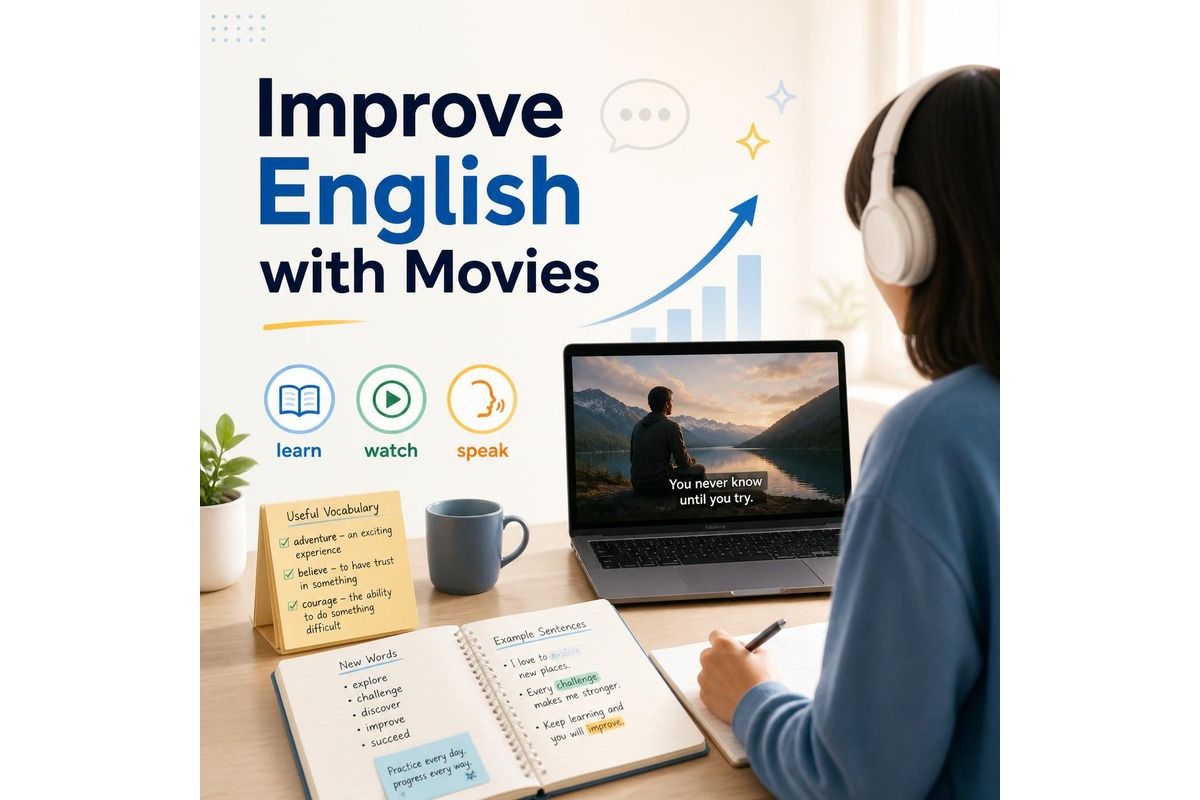
Watching movies is not only a form of entertainment. It can also be an enjoyable and effective way to improve your English. Movies allow you to hear English in real conversations and see how people use words and expressions in different situations.
Many English learners study grammar and vocabulary from books but find it difficult to understand spoken English. This is because English can sound very different in real conversations. People may speak quickly, use common expressions, or pronounce words differently from how learners expect.
Watching movies can help you become more familiar with natural English. You can improve your listening skills, learn new vocabulary, understand pronunciation, and practice speaking.
However, simply watching movies is not enough. You need to watch them in the right way and actively pay attention to the language.
In this article, you will learn how watching movies can improve your English and how to use movies as part of your English-learning routine.
1. Watching Movies Improves Listening Skills
One of the biggest benefits of watching movies is that they can help improve your English listening skills.
In textbooks, English is often presented clearly and slowly. In movies, however, people speak more naturally. You can hear different speaking speeds, accents, pronunciation styles, and expressions.
Movies can help you become familiar with:
- Natural English pronunciation
- Different accents
- Common expressions
- Different speaking speeds
- Everyday conversations
- Connected speech
At first, you may understand only a small part of the conversation. This is normal. Do not become discouraged if you cannot understand every sentence.
With regular practice, your brain gradually becomes more comfortable with spoken English.
You can also use trusted resources like BBC Learning English for daily listening practice.
2. Learn New Vocabulary in Context
Another important benefit of watching movies is learning vocabulary in context.
Memorizing a list of words can help you remember their definitions, but it does not always teach you how to use them correctly. Movies show you how words and phrases are used in real situations.
For example, you may hear a character say:
“I will take care of it.”
From the situation, you can understand that “take care of it” means dealing with or handling something.
This is more useful than simply memorizing the phrase from a vocabulary list because you can see how it is used in a real conversation.
When watching a movie, pay attention to:
- New words
- Common phrases
- Phrasal verbs
- Expressions
- Useful sentence patterns
- Words used in different situations
You do not need to write down every new word. Choose only useful words and expressions that you are likely to use.
3. Improve Your English Pronunciation
Movies can also help you improve your pronunciation.
When you listen to native English speakers, you can hear how they pronounce words and sentences naturally. You can notice which parts of a sentence are stressed and how words connect during normal speech.
One useful method is imitation.
Choose a short sentence from the movie and listen to it carefully. Pause the movie and repeat the sentence. Try to copy the speaker’s pronunciation, rhythm, and stress.
A simple process is:
- Listen to the sentence.
- Pause the movie.
- Repeat the sentence.
- Listen again.
- Repeat it several times.
You do not need to copy the actor perfectly. The purpose is to train your mouth and ears to become more comfortable with English pronunciation.
This practice can also make speaking English feel more natural.
4. Practice Speaking Through Movies
Although movies mainly provide listening practice, they can also help you develop your speaking skills.
A simple technique is to repeat useful sentences from the movie. You can pause after a character speaks and say the sentence yourself.
Another useful method is to describe what is happening in the scene.
For example, if two people are having a conversation in a restaurant, you could say:
“They are talking about their plans for the weekend.”
You can also try to predict what a character will say before listening to the next sentence.
These activities turn passive movie watching into active English practice.
If you want to improve your speaking, try to speak aloud instead of only listening.
You can also read our guide on how to improve English speaking skills for more detailed practice methods.
5. Learn English in Real-Life Situations
Movies contain many situations that are similar to everyday life.
You may see people:
- Ordering food
- Asking for directions
- Meeting new people
- Making plans
- Apologizing
- Asking for help
- Giving advice
- Having conversations at work
- Talking with friends
- Solving problems
These situations help you understand how English is used outside the classroom.
For example, you may learn different ways to ask someone for help. You can also notice how people speak differently when talking to a friend, a colleague, or someone they do not know well.
This can improve your understanding of both formal and informal English.
6. Understand English Expressions More Easily
English contains many expressions that cannot always be understood by translating each word separately.
Movies give you the opportunity to hear these expressions in context.
For example:
- “What’s going on?”
- “Give me a minute.”
- “That makes sense.”
- “I have no idea.”
- “Are you serious?”
- “It depends.”
When you hear these expressions repeatedly, you can gradually remember them as complete phrases.
This is useful because fluent speakers often use common phrases rather than creating every sentence word by word.
Try to remember useful expressions as groups of words, not only as individual vocabulary items.
7. Use English Subtitles Correctly
Subtitles can be very helpful, especially for beginners and intermediate learners.
However, you should use them carefully.
If you always watch movies with subtitles in your native language, you may spend more time reading your native language than listening to English.
A better approach is to use English subtitles when possible.
A Simple Subtitle Method
Step 1: Watch with English subtitles
Listen to the English and read the English subtitles at the same time.
Step 2: Notice unfamiliar words
Write down only useful words or expressions.
Step 3: Watch the scene again
Try to understand the conversation more easily the second time.
Step 4: Watch without subtitles
Turn off the subtitles and test how much you can understand.
You do not have to stop using subtitles completely. They are a useful learning tool, especially when a sentence is difficult to understand.
8. Practice Active Watching
There is a big difference between watching a movie for entertainment and watching it for English practice.
When you watch only for entertainment, you may not pay much attention to the language.
Active watching means paying attention to the English while you watch.
You can:
- Pause difficult scenes.
- Repeat useful sentences.
- Write down new vocabulary.
- Notice pronunciation.
- Read English subtitles.
- Repeat conversations aloud.
- Try to understand expressions from context.
You do not need to do all of these activities throughout the entire movie.
For example, you could watch the first 20 minutes normally and then spend 10 minutes actively studying a few useful scenes.
This makes movie watching more practical for English learning.
9. Choose Movies That Match Your English Level
Choosing the right movie is important.
If the movie is far above your English level, you may become frustrated because you cannot understand most of the dialogue.
Choose movies that are challenging but still understandable.
For Beginners
Look for movies or shows with:
- Clear pronunciation
- Simple vocabulary
- Short conversations
- Familiar everyday situations
For Intermediate Learners
You can choose content with:
- Normal conversation speed
- Everyday vocabulary
- More complex conversations
- Different accents
For Advanced Learners
You can challenge yourself with:
- Fast conversations
- Different accents
- Complex vocabulary
- Professional situations
- More difficult expressions
The goal is not to understand every word. The goal is to understand more English over time.
10. Watch Regularly
Consistency is more important than watching a large amount of content only once.
Watching one movie every few months will not provide enough regular exposure to English.
Instead, create a simple routine.
For example, you could practice English through movies two or three times a week.
You do not even need to watch an entire movie every time. A 20–30-minute section can provide useful practice.
Regular exposure helps you become more comfortable with English pronunciation, vocabulary, and natural conversations.
Small amounts of regular practice can be more useful than studying for a long time only once in a while.
11. Try a 30-Minute Movie English Practice Routine
If you are not sure how to start, try this simple routine.
First 10 Minutes: Watch
Watch a short section of a movie with English subtitles.
Focus on understanding the general meaning rather than translating every word.
Next 10 Minutes: Study
Choose three to five useful words or expressions.
Write them down and check their meanings.
Then listen to the sentences again.
Last 10 Minutes: Speak
Repeat several sentences aloud.
Try to copy the pronunciation and rhythm of the speakers.
You can also create your own sentences using the new expressions.
This simple routine can turn 30 minutes of entertainment into useful English practice.
You can also follow a structured plan in our guide on how to practice English every day.
12. Learn Culture and Communication
Language and culture are closely connected.
Movies can help you understand how English speakers communicate in different situations. You can observe greetings, politeness, humor, body language, and social behavior.
For example, you may notice that people use different expressions when speaking with a close friend compared with someone they have just met.
Movies can therefore teach you more than vocabulary and grammar. They can also help you understand the social context behind communication.
However, remember that movies are fictional or dramatized. Not every behavior shown in a movie represents how everyone in an English-speaking country behaves.
Use movies as one source of cultural learning rather than assuming that every scene represents real life.
13. Do Not Try to Understand Every Word
One common mistake among English learners is trying to understand every single word.
This can make movie watching stressful.
Native speakers also sometimes miss words when listening to fast conversations.
Instead, first try to understand the main idea.
Ask yourself:
- Who is speaking?
- What are they talking about?
- What is happening?
- What is the speaker trying to say?
If you understand the main message, you do not need to stop for every unfamiliar word.
You can return to important sentences later and study them more carefully.
14. Combine Movies with Other English Skills
Movies are an excellent learning tool, but they should not be your only method of learning English.
For balanced improvement, combine movies with:
- Speaking practice
- Reading
- Writing
- Vocabulary study
- Grammar practice
- Listening exercises
For example, after watching a movie, you could write a short paragraph about the story.
You could also describe your favorite character, summarize a scene, or write down five new expressions that you learned.
This allows you to use several English skills together.
15. Use Reliable English Resources Alongside Movies
Movies are useful, but sometimes you may hear an expression that you do not understand.
When this happens, check the word or phrase using a reliable English-learning resource or dictionary.
Resources such as BBC Learning English provide useful materials for studying vocabulary, pronunciation, grammar, and everyday English.
Using additional learning resources can help you understand expressions that may be difficult to understand from the movie alone.
Conclusion
Watching movies can be an enjoyable and effective way to improve your English. Movies expose you to natural conversations, different accents, useful vocabulary, pronunciation, and real-life communication.
However, the way you watch matters. Instead of simply watching movies for entertainment, try active watching. Use English subtitles, write down useful expressions, repeat sentences, and practice speaking aloud.
You should also choose movies that match your English level and watch regularly. Even 20–30 minutes of focused practice several times a week can become a useful part of your English-learning routine.
Most importantly, do not worry about understanding every word. Focus on understanding the main message and gradually increase the amount of English you can understand.
If you combine movies with reading, writing, speaking, vocabulary, and other listening activities, you can make steady progress in your English.
Frequently Asked Questions (FAQ)
1. Can watching movies really improve English?
Yes. Watching movies can help improve listening, vocabulary, pronunciation, and understanding of natural English conversations. Active practice makes movie watching more useful for learning.
2. Should I watch movies with English subtitles?
Yes. English subtitles can be especially useful for beginners and intermediate learners. They allow you to connect the words you hear with the words you read. You can gradually try watching without subtitles.
3. How often should I watch movies to improve my English?
Try to practice two or three times a week. You do not need to watch an entire movie every time. Even 20–30 minutes of focused practice can be useful.
4. Is watching movies better than reading books for learning English?
Both are useful, but they develop different skills. Movies are particularly useful for listening, pronunciation, and understanding conversations. Books are useful for reading, vocabulary, grammar, and writing.
5. What type of movies should beginners watch?
Beginners should choose movies or shows with clear pronunciation, simple vocabulary, and everyday conversations. Content that is too difficult can make learning frustrating.
6. Should I use subtitles in my native language?
It is better not to depend on them. Native-language subtitles can help you understand the story, but they may reduce your attention to English. Try English subtitles when possible.
7. How can I learn vocabulary from movies?
Write down a small number of useful words and expressions while watching. Check their meanings and then listen to the sentences again. Finally, try using the new words in your own sentences.
8. Can movies improve English speaking skills?
Yes, especially when you actively repeat sentences and imitate the speakers. Pausing the movie and speaking aloud can help you practice pronunciation, sentence structure, and fluency.